Stop Calling It ‘Smart-Casual’: The Dress Code That Means Nothing
It appears on wedding invitations, office handbooks and restaurant websites, and almost nobody agrees on what it asks of us. It is time to retire the phrase and be specific.

Above: Photo: Pexels / Pixabay.
Last month I received an invitation to a 40th birthday dinner in Bristol. The card was handsome, the venue was a converted wool exchange, and at the bottom, in discreet italic, were two words: smart-casual. I spent the following evening standing in front of my wardrobe, wondering what on earth they meant.
I have been writing about menswear for 16 years and I still cannot answer. Does smart-casual allow jeans? A tie? A blazer with trainers? A knitted polo? Ask ten friends and you will get ten confident, mutually contradictory answers. The phrase has become a kind of social placebo: it suggests guidance while giving none.

Above: Photo: FrankyFromGermany / Pixabay.
A term with no centre
The trouble is its construction. “Smart” and “casual” are opposites, and the phrase splits the difference without telling you where the split falls. To one host, smart-casual means a jacket and open collar. To another, it means a clean shirt and no shorts. To a third, it means whatever they are wearing themselves.
A recent survey by the hospitality group Linnetfield & Dene, covering 2,300 diners across England, found that 41 per cent believed trainers were acceptable under smart-casual, while 38 per cent thought they were not. A further 21 per cent had no idea. On jeans the split was nearly even. On a jacket, 62 per cent said it was required, and 29 per cent said it was optional.
That is not a dress code. That is a coin toss.
The costs of vagueness
It might seem a small matter, but vagueness has consequences. Men with less social confidence, or less money, are disadvantaged. Someone who has never been to a formal restaurant has no way of knowing whether a pair of dark jeans will pass. The stakes are low in theory and quietly humiliating in practice, the shame of arriving under- or over-dressed to find the room has reached a different conclusion.
It also creates a perverse incentive to overdress. Faced with ambiguity, most men reach for a suit. At a barbecue or a pub supper, the suit then becomes its own error. The ideal of Brogue’s own tagline — well-dressed, never overdressed — is hard to meet when the host will not say what dressed means.
That is not a dress code. That is a coin toss.
What hosts could say instead
The remedy is not complicated. Hosts, restaurants and employers should simply describe what they want. A few options that work:
- “Jacket required, tie optional.” Clear, and useful for men who own a blazer but not a suit.
- “Collared shirt, no trainers.” Precise enough to avoid arguments at the door.
- “Dress as you would for a good Sunday lunch.” Evocative, and surprisingly accurate.
- “Lounge suit.” Old-fashioned, but everyone who understands the term knows what to wear.
Some establishments already do this. A restaurant in Edinburgh, Ardlow House, lists its policy in three sentences on its website: jackets welcome but not necessary, no sportswear, no shorts after 6pm. Its manager, Fergus Maltravers, says bookings from first-time diners have risen since the change. “People tell us they were relieved. They did not have to guess.”
An argument for the guests
Guests have a role as well. When an invitation says smart-casual, ask. A short message to the host — “Are you thinking jackets?” — costs nothing and is, in my experience, always welcomed. Hosts rarely realise how opaque their wording is until someone points it out.
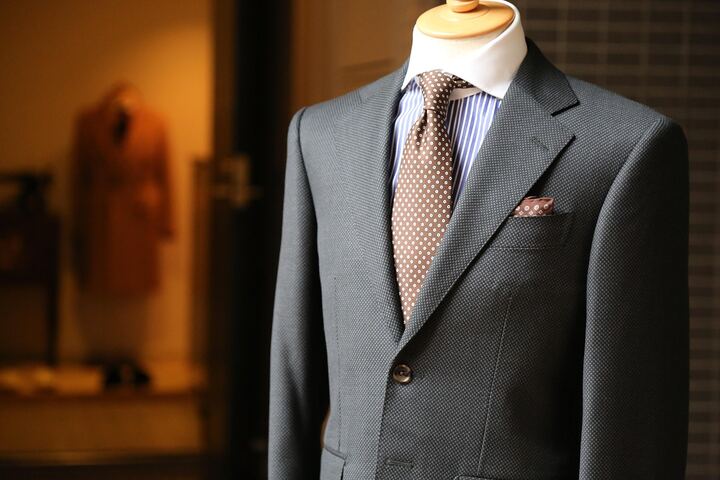
In the absence of an answer, the safest approach is to dress one notch above the venue. A dark pair of trousers or well-fitting selvedge denim, a pressed shirt, a plain jacket in navy or grey, and leather shoes. It will rarely be wrong, and it will almost never be too much. You may remove the jacket if the room proves relaxed; you cannot conjure one if it proves formal.
Retire the phrase
Language shapes behaviour, and “smart-casual” has trained a generation to dress for ambiguity: neither committed nor careless. A kinder, more useful habit would be to say what we mean. The birthday dinner, incidentally, turned out to be jackets, shirts and polished shoes. I wore mine. So did everyone else. We all got it right, mostly by luck, and the host never knew how many wardrobe crises her two italic words had caused.
Tabitha covers everyday menswear, footwear and the dress codes of modern offices, and previously worked on a regional fashion magazine. She is based in Bristol.
More from TabithaThe Sunday Shine
One letter every Sunday morning: the week in men’s style, the dress code for the days ahead, and one pair of shoes worth polishing.
Correspondence
Opening the post…